 Noah Karsky
Mushrooms Follow the Rain: An Ode to texasmushrooms.org
There is a website called texasmushrooms.org that I stumbled upon one day that I think more people should know about. I’ve never really seen it referenced anywhere. Granted, I haven’t looked that hard. It belongs to Alexey Sergeev, a math professor at Texas A&M who has been photographing his mushroom walks in the forests north of Houston since 2007. Over nineteen thousand pictures of more than twelve hundred species by his own count, and still growing. The site is responsive, informative, and he takes real care in capturing these photos. I don’t know how old he is or how the site is hosted. I just know it’s glorious, and part of me has always worried it could go away one day. That worry is where this project started.
So I scraped the website and built something on top of it: a map and a calendar of seventeen years of one man’s mushroom photographs.
But first the backstory, because it’s a funny one.
The Email
Six or seven years ago, when I was first getting into mushrooms and also wanting to work on my data science skills, I emailed Alexey to ask if I could scrape his website. He replied thinking I was somebody else. There was apparently some other collaborator of his at the college whose name was also Noah, and he answered me like I was that guy. I don’t have the email anymore, but I’m pretty sure what he sent back was a simulation of a plane blowing up.
This was during the peak of the Russian election interference stuff. So here I am, a guy who just wanted to ask about mushrooms, and this super Russian stranger is sending me plane explosion simulations. I immediately thought I was going to end up on some FBI list just for having this in my inbox. I was laughing about it, and also a little bit actually worried about it.
I replied something like, that’s cool, however I’m mostly interested in the mushrooms. We kept in touch, I never got around to scraping the website back then; however eventually I asked him something better. Could I join him on a mushroom hike?
The Hike
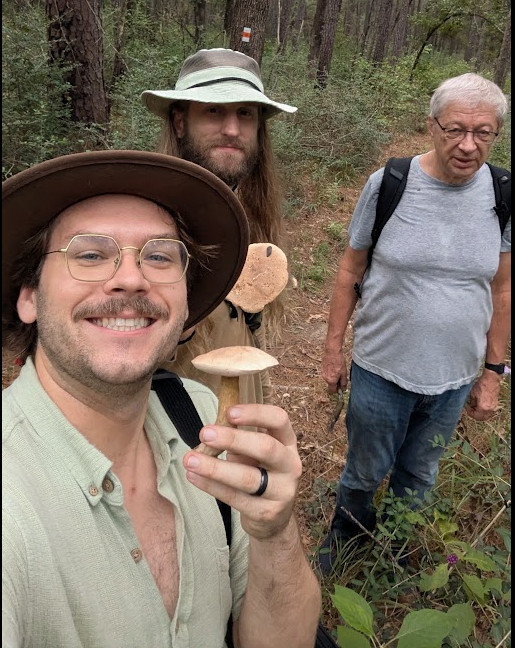
He was kind enough to invite me out to a remote trailhead on the Lone Star Hiking Trail up in Sam Houston National Forest. Lindsey was super worried, because it was just me meeting some stranger from the internet alone in the woods, and I don’t know what I was thinking either. I just figured he was a cool old guy who could teach me about mushrooms. Which is exactly what he turned out to be.
Alexey is really quiet, sort of an eccentric man who talks very softly, and maybe some of that is just the language barrier. He hikes in jeans and just trucks along. He drives out, does his hike in the morning, and drives back, so he moves pretty quick through the forest. Except when he doesn’t.
Within minutes of starting we stopped dead at this little orange thing on the ground. He got down and spent a good three minutes photographing it. He will probably not like me bringing this up, but I’m pretty sure it was an actual orange peel. We never acknowledged it. We just kept hiking along and I laughed to myself. I keep that memory around as a reminder to stay humble. This is a guy who knows basically every mushroom in East Texas, and even he can spend three minutes carefully photographing somebody’s litter.
Because he really does know every mushroom. He entwines himself with the forest. He’s always touching the plants, which I love too, because I’m also a plant toucher. My wife hates it. He’ll pick up a mushroom and rattle off the Latin name like it’s nothing, then hand it to me like I’m supposed to know exactly what he’s talking about. I know a lot of the common names for these things. He basically doesn’t use them. He’s always keen to tell you about the rarity of a find, or about somebody he knows who’s studying some subspecies or trying to catalog the rust fungi. And every now and then a Tupperware container comes out of the pack and a sample goes in, for spore prints or for sending off to people.
By our last hike he had gotten more social and was making KGB jokes. He’s really funny once you get to know him a little. We like talking about coding, his website, and using AI for various things. We should collaborate more and I should reach out more, but I’m a punk. I’ve also still never joined him for the Central Texas Mycology walks he goes to, which is more punk behavior on my part. Someday I’ll take time off work and do the guided mushroom hikes. I’m sure there are other great people out there.
The Project
The long term dream is a mushroom prediction app. Something that answers the question, should I go outside and look for mushrooms right now? Someday I might come full circle and build that little application. In the meantime, I thought a nice visualization would be cool.
The Seasons
The centerpiece is a seasonal visualization. We wrote a function that gets the rough color of each mushroom and plots all 8,800 photos as dots along the day of the year they were taken, one row per year, each dot painted in the mushroom’s own color.
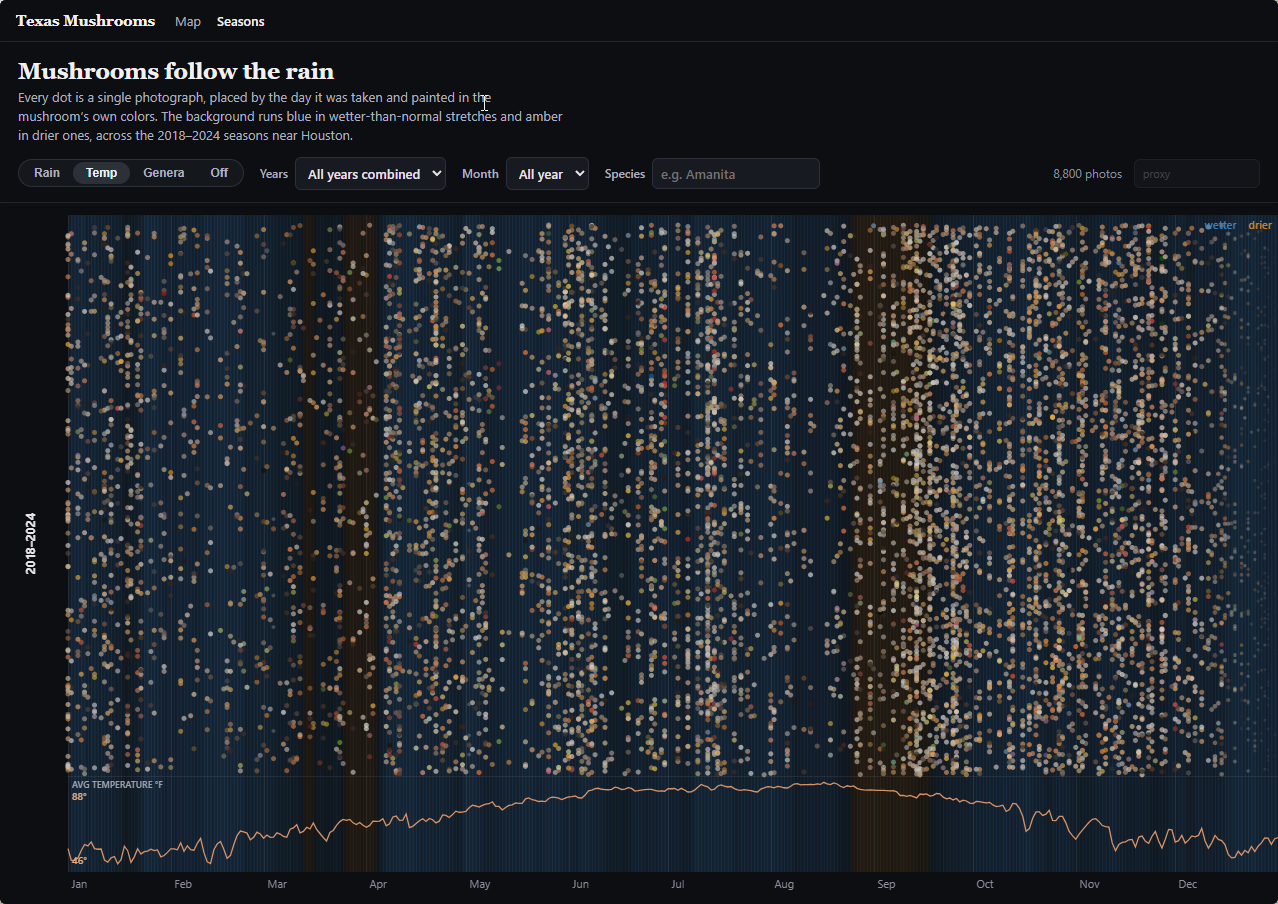
Getting the color right was the interesting part. We ran into scenarios where there was a lot of background in the photos, so everything came out as shades of brown. Leaf litter, dirt, bark. We had to correct for that, and I think we now do a little bit better of a job getting the true color of the mushroom. People don’t give enough credit to all the variations of mushrooms we get here in Texas, specifically north of Houston in Sam Houston National Forest. Amanita jacksonii colors are some of my favorite ones to find. And since Alexey photographs a lot of smaller mushrooms and doesn’t shy away from slime molds, some lichens and things have probably slipped into the dataset too. That’s okay. It’s a first pass at honoring the many, many thousands of photos he’s taken.
Behind the dots there are different ways to visualize it. One shows dryness, so you can see mushroom seasonality against how uncharacteristically dry it is, and another shows rainfall. The weather comes from Open-Meteo’s historical archive for the same patch of forest, which answers the question I could never remember, of where exactly we were sampling from.
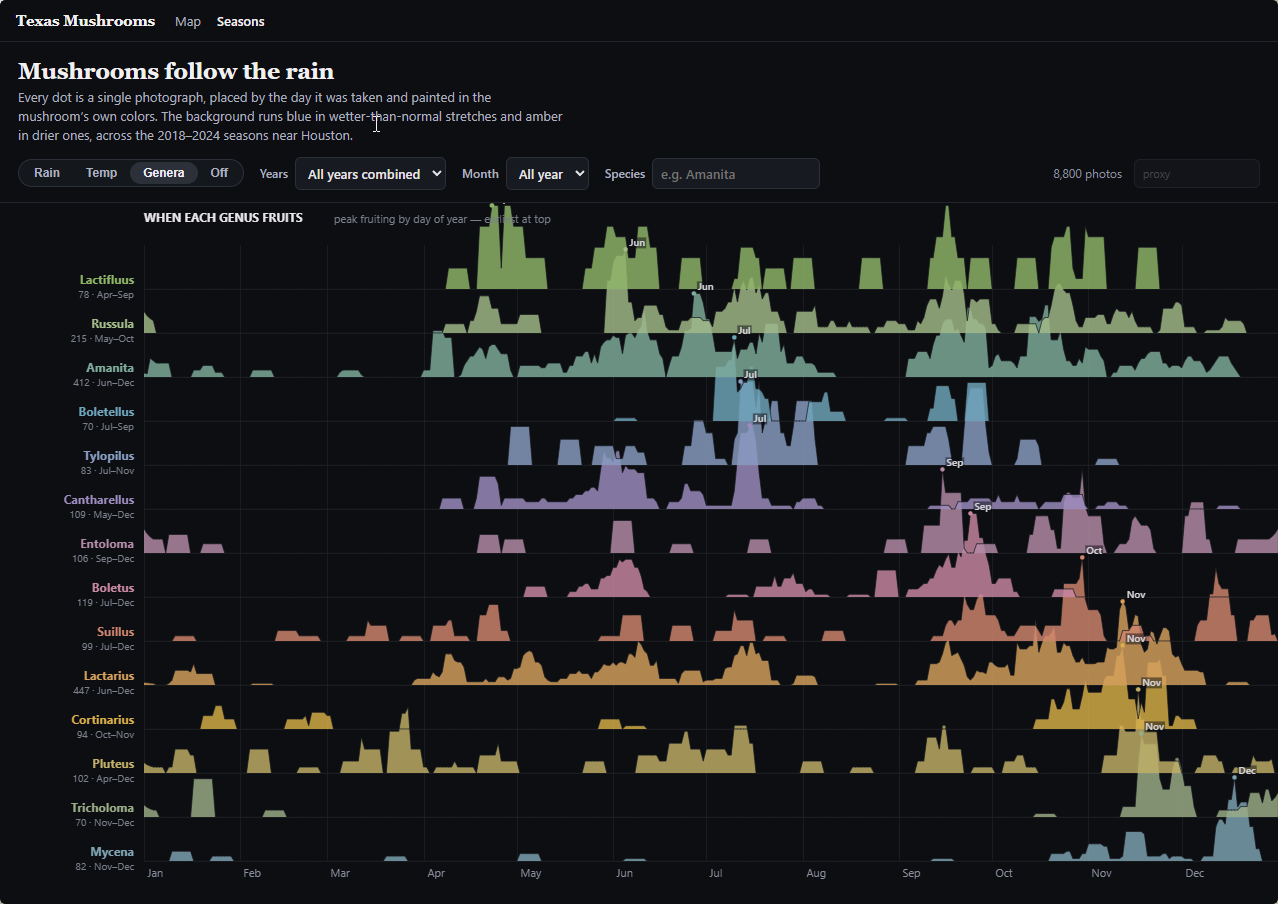
On the mushrooms follow the rain page there’s also a really cool one that plots the distribution as a histogram through time, showing when each genus fruits. Super cool data visualization. And you can put all the years combined into one day of the year view, and it just shows thousands of dots of all various colors.
The Map
Alexey, it turns out, tracks his….exact path from his house….which we take advantage of! In a non-creepy way! Every day page has a track log attached, and the waypoint names match up with his photo filenames, which is why almost every photo in the archive has real coordinates.
The map visualizes all of his locations as H3 cells. I also wanted to supplement his data, so I scraped a bunch of iNaturalist observations in the same general area, kept as a separate layer you can toggle against his. It’s a pretty simple map interface where you can see his mushroom locations, the iNaturalist mushroom locations, and where the most mushrooms are being found.
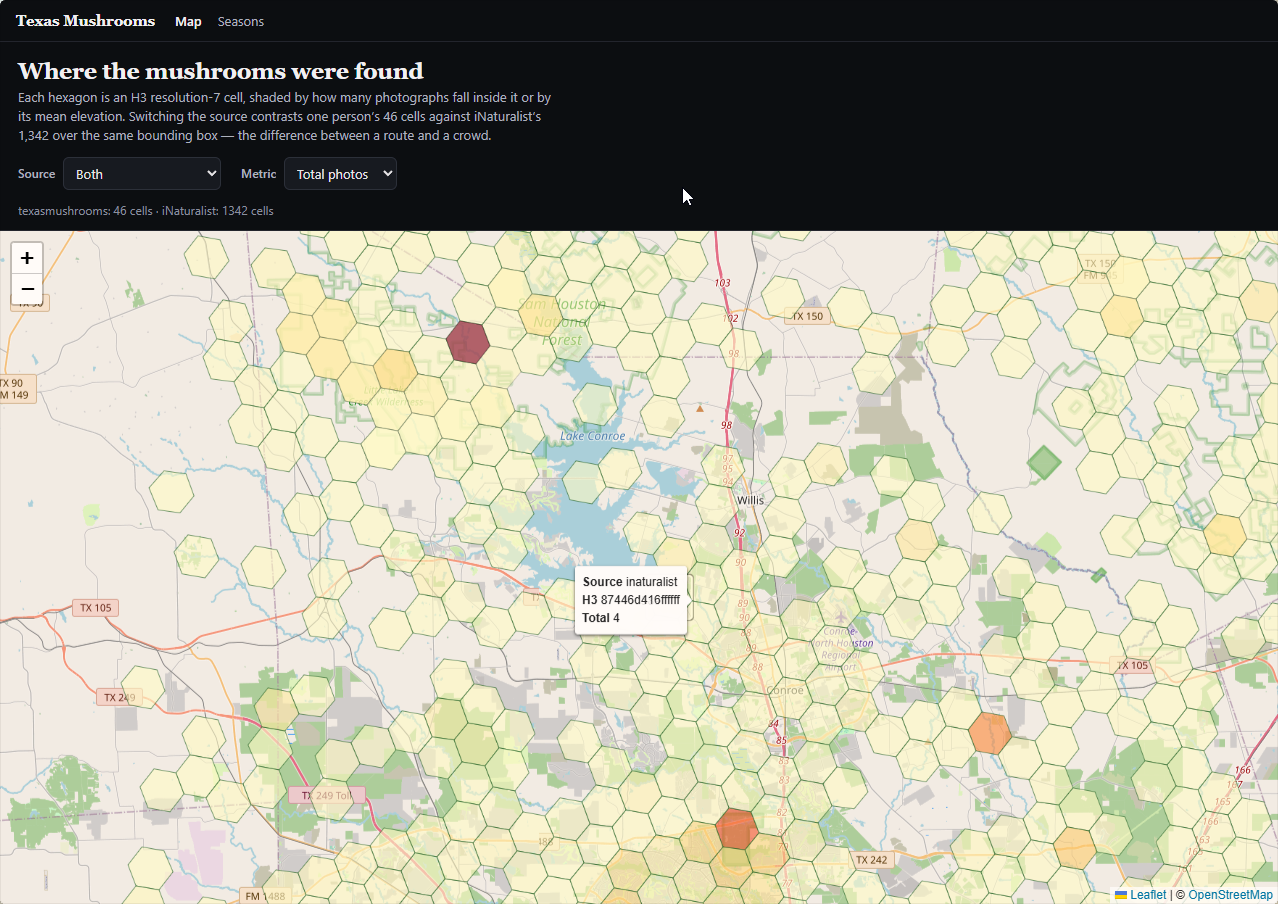
There’s obviously huge bias towards location in all of it. People mostly take mushroom photos when it’s nice outside, when it’s not muddy, and only in certain areas. We don’t have an even distribution, so there’s lots of variables to account for. We’ll have to do some special geospatial data science to control for all that, and there’s probably some pretty cool stuff to do there that I haven’t dug into yet. I’ll do more with that in the future.
Go Look
The visualization site is live at noahkarsky.github.io/texas-mushrooms, and the pipeline is on GitHub.
But mostly, go look at texasmushrooms.org. The photographs and captions are all Alexey’s, and they’re glorious. Everything I built is just a frame around them.
Noah’s Notes
Alexey, if you ever read this: thank you for all your hard work documenting mushrooms for all of us to learn from and admire the wonderful world of mycology. It means more than you know.
Get new posts by email
One message per post. Nothing else.
No tracking, no selling, no other mail. Unsubscribe link in every message.